 English
 한국어
 Español
 Português
 Türkçe
 Русский
 Deutsch
Game guide
Crypto Plinko: Rows, Risk Levels and Real Odds at Bitcoin Casinos
Crypto plinko explained: Stake and BGaming 99% RTP, Spribe 97%, how rows and risk levels change the odds, 1,000x edge-slot maths and how to verify a drop.

Disclosure We may earn a commission when you click links to operators. Partners can sit higher on our lists, but commission never changes a rating. Editorial policy
Crypto plinko is a casino game in which a ball drops through rows of pegs and lands in a slot with a multiplier; you choose the stake, the number of rows and a risk level before each drop. The versions with the best published returns are Stake’s Plinko (1% house edge, up to 10,000x on its Expert setting) and BGaming’s Plinko (99% RTP, up to 1,000x), while Spribe’s Plinko lists a 97% RTP. Provably fair house versions also run at Roobet and Winna. Below we compare where to play crypto casino plinko with Bitcoin, Ethereum or USDT, show what rows and risk levels really do to your odds, and explain how to check a drop yourself.
The casinos listed accept international players outside each brand’s restricted list. None of them accepts players from the United States or the United Kingdom; US readers can see our guide for US crypto players.
- 1

Roobet
+10% rakeback boost for 24 hours, then rakeback every 30 minutes
- 11 cryptocurrencies on multiple networks
- 15 provably fair house games
- 24/7 live support
Visit siteRead review18+. No deposit-match welcome bonus. Each deposit must be wagered once before withdrawal. Not available in the US, UK, Australia or the Netherlands. T&Cs apply. - 2

Winna
VIP rewards, instant rakeback and status transfer
- 13 supported cryptocurrencies
- $20 minimum crypto withdrawal
- Provably fair Winna Originals
Visit siteRead review18+. Eligibility, wagering and country restrictions apply. Not available in the US or UK. T&Cs apply. - 3

BC.Game
Four monthly deposit stages (180–360%, up to 500% with the 24-hour New User Booster), locked and released as you wager
- BC Originals, lottery and sportsbook
- Large coin list with in-site swap
- Provably fair in-house games
Visit siteRead review18+. Booster for new users only; fiat minimums vary by currency. Unlock rules in BC.Game's bonus terms. T&Cs apply. - 4

Wild Tokyo
100% up to €800 + 200 free spins on the first deposit
- Up to €2,300 + 600 free spins over three deposits
- No-deposit free spins from the Wheel of Fortune
- Bitcoin accepted; €50 minimum crypto withdrawal
Visit siteRead review18+. New players. Up to €2,300 + 600 FS over 3 deposits; 50x wagering within 5 days; max bet €5. Not available in the US, UK, France, the Netherlands and other restricted countries. T&Cs apply. - 5

Stake
No fixed welcome match; rewards come through the VIP programme, rakeback and regular promotions
- Stake Originals (dice, crash, plinko, mines) with provably fair results
- Casino and sportsbook on one crypto balance
- Run by the team behind the former PrimeDice
Visit siteRead review18+. T&Cs apply. - 6

7Bit Casino
325% up to 5.25 BTC + 250 free spins over 4 deposits
- Over 10,000 games (operator figure)
- Crypto and fiat payments
- Weekly cashback up to 20%
Visit siteRead review18+. New players. Min qualifying deposit 40 in your local currency (e.g. 40 CAD) or crypto equivalent. 35x wagering, max bet set in the bonus terms in your account currency. T&Cs apply. - 7

Winz.io
Welcome Wheel of Winz spin with wager-free prizes (advertised up to 130 mBTC), or 20% daily crypto cashback for 7 days
- No-wagering welcome offer
- Casino and sportsbook
- Provably fair crash and plinko titles
Visit siteRead review18+. New players. Wheel tier by first deposit (Bronze 25, Silver 50, Gold 100 EUR or 0.001 BTC); no wagering on wheel prizes or cashback; free spins valid 1 day. T&Cs apply.
Which crypto casinos offer plinko?
Plinko crypto games we could confirm on operators’ own pages run at Stake, Roobet, Winna, BC.Game, 7Bit Casino and Winz.io. Stake, Roobet, Winna and BC.Game run in-house, provably fair versions; 7Bit Casino and Winz.io carry provider titles. Wild Tokyo appears in the list for its welcome offer, but we could not confirm a plinko title in its lobby, and it has no provably fair in-house games.
| Casino | Plinko we confirmed | Published return | Licence |
|---|---|---|---|
| Stake | Plinko (Stake Originals), 8 to 16 rows, four risk levels (low, medium, high, expert) | 1% house edge (99% RTP) | Curaçao Gaming Authority OGL/2024/1451/0918 |
| Roobet | Plinko, one of 15 provably fair house games listed on its Fair page | Check the game’s info panel | Curaçao Gaming Authority OGL/2024/687/0427 |
| BC.Game | Plinko (BC Originals) | Shown in the game’s info panel | Anjouan ALSI-202410011-FI1 |
| Winna | Plinko (Winna Originals); max bet $10,000 and max win $400,000 per bet | Check the game’s info panel | Tobique Gaming Commission (operator-stated) |
| 7Bit Casino | Plinko among its crypto instant games | Depends on the provider version; check the game’s info panel | Tobique Gaming Commission 0000091 |
| Winz.io | Provably fair plinko titles | Depends on the provider version | Anjouan ALSI-202508056-FI2 |
Stake’s in-house version is the one whose maths we can document fully, so the examples below use it. See our Stake review and BC.Game review for payments, limits and KYC rules before you deposit.
Which plinko version has the best RTP?
Stake’s in-house Plinko and BGaming’s Plinko both publish a 99% RTP, the best figure among the versions we could document. Stake’s game tops out at 10,000x on its Expert setting with 16 rows, and BGaming’s at 1,000x. Spribe’s Plinko lists a lower 97% RTP. On 1 BTC wagered, that is an expected cost of 0.01 BTC on the 99% games against 0.03 BTC on Spribe’s, three times as much for the same play.
| Game | Made by | Rows | Risk settings | Stated RTP | Top multiplier |
|---|---|---|---|---|---|
| Plinko | Stake (in-house) | 8 to 16 | Low, medium, high, expert | 99% | 10,000x (16 rows, expert); 1,000x at high risk |
| Plinko | BGaming | 8 to 16 lines | Low, normal, high | 99% | 1,000x |
| Plinko | Spribe | Adjustable number of pins | Three coloured buttons | 97% | 555x maximum win |
| Plinko | BC.Game (in-house) | Adjustable | Several risk levels | See the info panel | See the info panel |
BGaming’s game page states the 99% RTP and x1,000 top multiplier, lets players pick from three risk levels and 8 to 16 lines, offers manual and auto modes, and says the game is provably fair with server and client seeds. Spribe’s page lists a 97% RTP and explains that each of three coloured buttons drops its own disc, with the number of pins adjustable to change difficulty. Spribe also notes the game’s roots in a popular American TV game show, which is where the name comes from.
How do you play plinko with crypto?
Playing plinko with crypto takes five steps: fund your casino balance in a coin such as BTC, ETH or USDT, set the stake, choose the number of rows, choose a risk level and drop the ball. The slot where the ball lands sets the multiplier, and the payout goes straight back to your balance in the same coin.
- Pick a coin and stake. Plinko accepts tiny stakes, so a BTC, LTC or USDT balance works at almost any size.
- Choose the rows. More rows mean more bounces, a wider board and more extreme edge multipliers.
- Choose the risk level. Low risk keeps multipliers close to 1x; high risk pushes value to the edges and puts sub-1x multipliers in the middle.
- Drop. Each peg sends the ball left or right with equal chance, and the slot it lands in sets the payout.
- Auto mode (optional). Set a number of drops with stop-loss and stop-win limits, so a session ends on your terms.
Why does the plinko ball land in the middle so often?
With equal left and right bounces, the slot a ball reaches follows a binomial distribution: on a 16-row board there are 65,536 equally likely paths, and only one of them ends in each corner. That single fact explains most of plinko.
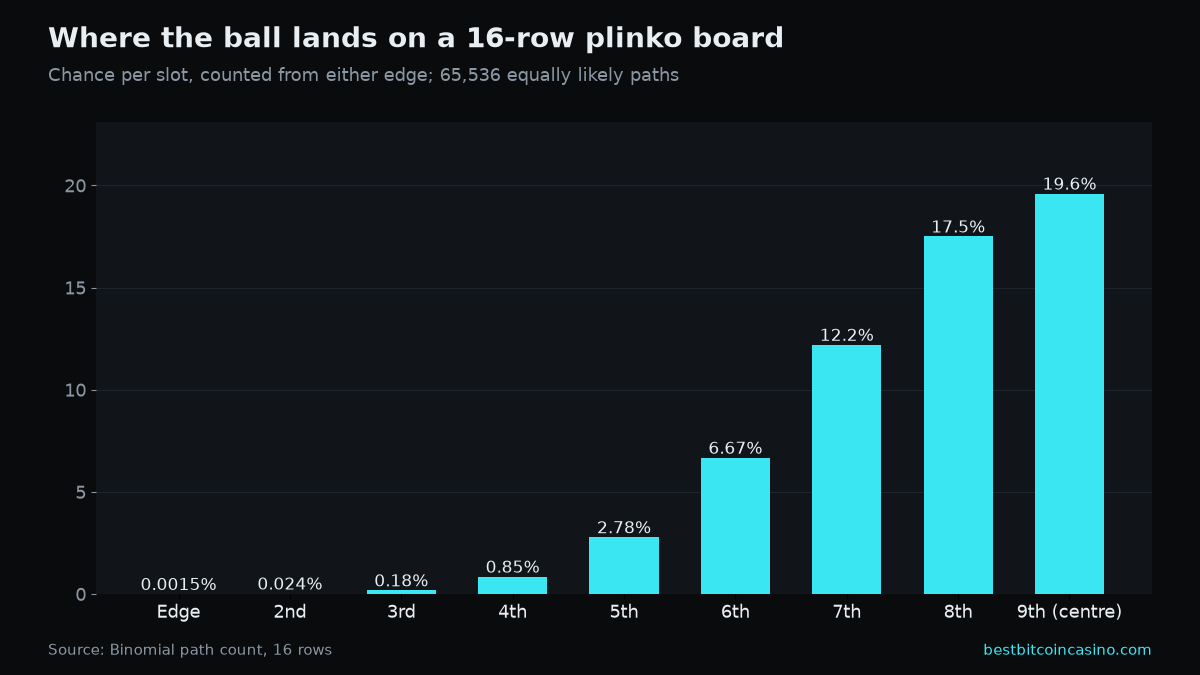
| Slot (from either edge) | Paths out of 65,536 | Chance per slot | Stake multiplier, 16 rows, high risk |
|---|---|---|---|
| Edge | 1 | 0.0015% (1 in 65,536) | 1,000x |
| 2nd | 16 | 0.024% | 130x |
| 3rd | 120 | 0.18% | 26x |
| 4th | 560 | 0.85% | 9x |
| 5th | 1,820 | 2.78% | 4x |
| 6th | 4,368 | 6.67% | 2x |
| 7th to 9th (centre) | 8,008 / 11,440 / 12,870 | 12.2% / 17.5% / 19.6% | 0.2x |
Read across the table and the shape of the game is clear. On 16 rows at high risk, the ball lands on a 0.2x slot about 79% of the time, so four drops in five return a fifth of the stake. One drop in roughly 32,768 hits either 1,000x corner. Multiply each chance by its multiplier and add them up, and the board returns about 99% of stakes: the 1% edge again, spread very unevenly.
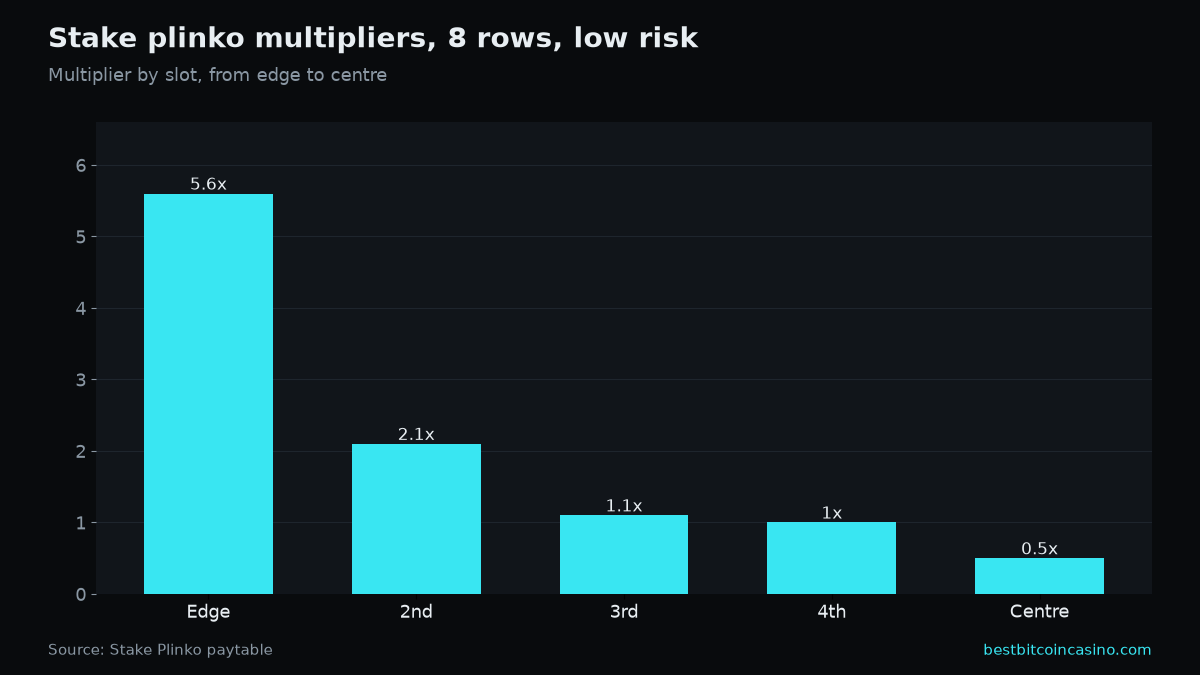
Low risk flips the experience. Stake’s top Expert level goes further still, with a 10,000x corner on 16 rows. On Stake’s 8-row low-risk board the multipliers run 5.6x, 2.1x, 1.1x, 1x and 0.5x from edge to centre. There, about 73% of drops return the stake or more, and the worst result is half the bet, but the top prize is only 5.6x. The expected return is still about 99%.
The 8-row low-risk board, slot by slot
An 8-row board has 256 equally likely paths, so the odds are easy to list in full. Each multiplier below is Stake’s 8-row low-risk value, read from edge to centre.
| Slot (from either edge) | Paths out of 256 | Chance per slot | Multiplier |
|---|---|---|---|
| Edge | 1 | 0.39% | 5.6x |
| 2nd | 8 | 3.1% | 2.1x |
| 3rd | 28 | 10.9% | 1.1x |
| 4th | 56 | 21.9% | 1x |
| Centre | 70 | 27.3% | 0.5x |
Counting both sides, 186 of the 256 paths end on 1x or better, which is where the figure of about 73% comes from, and 70 paths end on the 0.5x centre. Add up each chance times its multiplier and the board returns 98.98%, the same as the 16-row high-risk board to two decimal places.
Worked example in BTC
Say you drop 0.0001 BTC 1,000 times: 0.1 BTC wagered. At a 1% edge the expected cost is 0.001 BTC whichever risk level you pick. On the low-risk 8-row board your balance will usually end close to that figure; on the high-risk 16-row board most sessions end well below it and a rare few end far above, because a single 1,000x corner pays 0.1 BTC. Volatility changes the spread of results, not the average.
How big a balance does high-risk plinko need?
On Stake’s 16-row high-risk board, only the slots from 9x outward pay well: counting both sides, 1,394 of the 65,536 paths end on 9x or more, a chance of about 2.1% per drop, or roughly 1 drop in 47. Slots of 2x or more add up to 13,770 paths, about 21% of drops.
| Drops in a row | Chance of no 9x-or-better result |
|---|---|
| 50 | About 34% |
| 100 | About 12% |
| 200 | About 1.4% |
So roughly one session in eight of 100 drops passes without a single 9x hit, and most of those drops return 0.2x. A balance of 100 stakes can survive that, but only just; a balance of 20 stakes often cannot. If you play high risk, size the stake so that 200 drops fit your budget, or drop to medium or low risk where runs are shorter.
What do rows and risk levels change in plinko?
Rows and risk levels change how your results are spread, not what you win on average. More rows widen the board and make the edge slots rarer and bigger; a higher risk level moves value from the centre to the edges. On Stake, 8 rows at low risk pays from 0.5x to 5.6x, while 16 rows at high risk pays from 0.2x to 1,000x, and both return about 99%.
Choosing the number of rows
Each extra row doubles the number of paths. An 8-row board has 256, a 12-row board 4,096 and a 16-row board 65,536, so the chance of reaching one particular corner falls from 1 in 256 to 1 in 65,536. Few rows suit players who want frequent small returns; many rows suit players chasing the rare big multiplier who accept long runs without one.
Choosing the risk level
Risk levels reshape the paytable on a fixed number of rows. Low risk keeps most slots close to 1x, so a balance shrinks slowly. High risk drops the central slots well below 1x, 0.2x on Stake’s 16-row board, to pay for big edges. Some house versions add a fourth, more extreme level; whatever the name, check the paytable before you bet, because the shape is what decides how fast a balance can fall.
Which settings suit which player?
| Goal | Rows | Risk | What to expect |
|---|---|---|---|
| Long sessions on a small balance | 8 to 10 | Low | Most drops return 0.5x to 1.1x; slow, steady drift at the house edge |
| Bonus wagering, where allowed | 8 to 12 | Low | Lowest variance per unit wagered |
| Balanced play | 12 to 14 | Medium | Some sub-1x slots, mid-sized edges |
| Chasing the top multiplier | 16 | High or Expert | On High, about 79% of drops at 0.2x and 1,000x corners on 1 drop in 32,768; Expert raises the corners to 10,000x |
Is there a plinko strategy that works?
- No setting beats the edge. Every row and risk combination on a given game is built to the same RTP.
- Match risk to bankroll. High risk needs a balance that can survive long runs of 0.2x results; low risk suits small balances and bonus wagering.
- Keep stakes flat. Raising the stake after losses, as in Martingale, runs into bet limits quickly on a game where most drops lose part of the stake.
- Use auto limits. Stop-loss and stop-win settings stop a fast game from running away.
- Ignore patterns. Each drop is independent; the history board shows past results, not future ones.
How do auto play and fast modes work in plinko?
Auto mode drops a set number of balls without clicking, and most versions let you add stop-loss and stop-win limits. BGaming’s Plinko offers manual and auto modes, and Stake’s game panel has separate manual and auto tabs. Auto play does not change the odds; it only changes how quickly the house edge works through your balance.
Speed is the real issue. At roughly one drop a second, 1,000 drops take under 17 minutes, and at 0.0001 BTC a drop that is 0.1 BTC wagered with an expected cost of 0.001 BTC. Set the number of drops and both stop limits before you start, and treat a stop-win as a reason to end the session rather than to raise the stake.
- Number of bets: fix it in advance, for example 200 drops.
- Stop on loss: end the run when the net loss reaches your session budget.
- Stop on profit: bank a result instead of handing it back over the next few hundred drops.
- Stake changes on win or loss: leave these at zero; progressions do not change the edge and hit bet limits quickly.
What limits apply to plinko bets and wins?
Crypto casinos cap both the stake and the payout on plinko. Winna’s help centre lists a $10,000 maximum bet and a $400,000 maximum win per bet on its Plinko, and says the maximum bet adjusts to the risk level you choose so a single drop cannot exceed that exposure. Other casinos publish similar caps in the game panel or the terms.
Caps matter most on high-risk, many-row boards. At Winna, a $1,000 drop that hit a 1,000x slot would pay $1,000,000 on paper but is limited to $400,000, which is exactly why the maximum bet falls as the risk rises. Check the cap before you raise your stake, and remember that withdrawal limits in the casino’s general terms apply on top of any per-bet maximum.
How do you verify a plinko drop?
Provably fair plinko turns your seeds into one random number per row, and each number decides a left or right bounce. On Stake’s documented method, a single HMAC-SHA256 output gives 32 bytes, enough for eight 4-byte numbers; boards with more rows draw extra rounds. To check a drop:
- Note the hashed server seed shown before you play, and your client seed.
- Play, then rotate the seed pair so the casino reveals the old server seed.
- Confirm the revealed seed hashes to the value you were shown.
- Feed the server seed, client seed and nonce into the casino’s verifier or an independent script and compare the path (left or right for each row) with the slot your ball reached.
Our provably fair guide works through an 8-row plinko path byte by byte, and Stake documents the conversions on its provably fair game events page. Provider versions such as BGaming’s run their own seed system; use the verify button inside the game.
Roobet’s Fair page explains how each of its house game results is generated, Plinko included, and Winna publishes a technical description of its implementation, using HMAC-SHA256 and player-verifiable inputs for supported Originals. The checking steps are the same: note the hashed server seed, play, rotate seeds, then recompute. If a casino offers no seed details or verifier for its plinko, treat it as an ordinary RNG game and rely on its licence instead.
Is plinko cheaper than slots?
At 99% RTP, plinko costs less per unit wagered than a typical slot. On 0.1 BTC of total bets, a 1% edge costs 0.001 BTC on average, while a slot returning 96% costs 0.004 BTC, four times as much. The trade-off is entertainment: slots have features and bonus rounds, plinko has a ball and a paytable. Compare RTPs across games on our Bitcoin slots page.
How do deposits and withdrawals work for crypto plinko?
Plinko itself has no special banking rules: you deposit a coin into the casino balance, bet in that coin or its dollar equivalent, and withdraw winnings to your own wallet. Winna names 13 supported assets, including Bitcoin, Ethereum, Tether, USD Coin, Litecoin, Solana and Dogecoin, Roobet accepts 11 cryptocurrencies on several networks, and Stake runs casino and sportsbook on one crypto balance.
- Copy the deposit address for your coin from the cashier and check the network shown next to it.
- Send a small test amount from your wallet first; a transfer on the wrong network or to a wrong address is usually lost.
- Play once the casino credits the deposit after the confirmations it requires.
- To cash out, paste your own wallet address, pick the same network and confirm; Winna, for example, publishes a $20 minimum crypto withdrawal.
Network fees depend on the coin and on how busy the network is, so the cheapest route for small plinko balances is often a stablecoin or coin on a low-fee network rather than BTC or ETH on its main chain. Some casinos also run identity checks before larger withdrawals, whatever coin you use. Our crypto payment methods guide compares coins and networks, and the Tether casino page covers USDT.
Can you play crypto plinko on mobile?
Yes. Plinko runs in the mobile browser at every casino on this page, so no app download is needed, and the board scales to a portrait screen. Deposits are often easiest from a phone because the cashier shows a QR code that a mobile wallet can scan, which avoids copying a long address by hand.
Two habits help on a small screen. Check the rows and risk level before each session, since the settings panel is often collapsed on mobile and easy to change by accident. Turn off any fast or turbo animation setting if you want to watch results properly, and keep auto play limits switched on. Our mobile crypto casino guide covers wallet apps and security on phones.
What do the plinko controls on screen do?
Most crypto plinko games share the same layout: a pyramid of pegs in the centre, a row of multiplier slots along the bottom, and a control panel with the bet amount, rows, risk level and a manual or auto switch. A history strip shows recent results, and an info or fairness button opens the RTP, rules and seed details.
Colour usually tracks value, with the edge slots highlighted and the low centre slots in muted tones, but colours differ between games. Read the numbers, not the colours. The halve and double buttons next to the stake field change your bet in one tap, which is useful for quick adjustments and dangerous on a losing run.
Pros and cons of crypto plinko
Crypto plinko is simple, fast and, in the best versions, cheap to play, with a 1% house edge and results you can verify yourself. Its downsides are the same speed, which burns through a balance quickly in auto mode, and the high-risk settings, where most drops return a fraction of the stake.
- Pro: 99% RTP on Stake’s and BGaming’s versions, better than most slots.
- Pro: provably fair house versions at Stake, Roobet, Winna and BC.Game.
- Pro: stakes as small as a fraction of a cent in crypto.
- Pro: you control volatility through rows and risk.
- Con: no decisions during a round, so no skill edge.
- Con: very fast rounds, especially in auto mode.
- Con: originals are often excluded from bonus wagering.
- Con: per-bet win caps can limit the biggest multipliers.
Where does the name plinko come from?
Plinko comes from a pricing game on the American TV show The Price Is Right, where contestants drop discs down a large pegboard into cash slots. The game first aired in 1983. Spribe’s game page notes those TV roots, and casino versions keep the same idea of a disc bouncing left or right off pegs, with crypto multipliers in place of cash prizes.
Plinko vs crash vs dice: which crypto game suits you?
For plinko bitcoin gambling, the game is the most “hands-off” of the three crypto originals: once you pick rows and risk there is no decision during the round. Dice lets you set an exact win chance, and crash adds a timing decision. At Stake all three share a 1% edge, so the choice comes down to how much variance you want. Compare the maths on our crash games page and our crypto dice guide, or see every game type in the crypto casino games hub.
Should you try plinko in demo mode before betting crypto?
Yes, if a demo is offered. BGaming and Spribe publish free demo versions of their Plinko games, and many casinos let you open provider games in demo mode before you deposit. A demo uses the same rows, risk levels and paytables as the real game, so it shows how often each slot comes up without costing anything.
Use the demo to run a few hundred drops on the settings you plan to play and watch how far a balance swings. A demo cannot show everything, though. It does not test the cashier, withdrawal times or per-bet win caps, play-money balances do not feel like real coins, and in-house originals at crypto casinos usually need a funded account. Once you switch to real money, keep the same stake size you used in the demo, not a bigger one because the demo went well.
Common crypto plinko mistakes to avoid
Most plinko losses beyond the house edge come from a handful of habits: playing high risk on a small balance, running auto mode without stop limits, raising the stake after a run of 0.2x results, and using bonus money on a game the terms exclude. Each is easy to fix before you start.
- Mixing up settings: rows and risk often stay at the last values used, so check both before the first drop.
- Chasing a corner: a 1,000x slot has no memory; 30,000 drops without one is normal on 16 rows.
- Ignoring the RTP version: a 97% game costs three times as much as a 99% one for the same turnover.
- Wrong network on withdrawal: paste your own address and match the network the cashier shows.
- Ignoring caps: per-bet maximum wins and daily withdrawal limits both apply to big hits.
Is crypto plinko legal?
Whether crypto plinko is legal depends on where you live, not on the coin. The casinos on this page hold offshore licences from Curaçao, Anjouan or Tobique, and each excludes a list of countries, including the United States and the United Kingdom. If your country bans or licenses online casinos locally, an offshore licence does not make playing there legal for you.
Check the restricted-country list in a casino’s terms before you register, and do not use a VPN to get around it, since casinos can close accounts and withhold winnings when they find one. Our licence comparison explains what each regulator covers and how to complain if something goes wrong.
Can you use bonus funds on plinko?
Casinos set game weightings for bonus wagering, and in-house originals are often excluded or weighted low. Check the contribution table in the bonus terms before you use bonus money on plinko; a barred game can cost you the bonus and its winnings. Our welcome bonus guide explains wagering in crypto units.
How do you play plinko responsibly?
A drop takes a second and auto mode can run hundreds, so decide a budget first and use stop-loss limits. Casinos on this page offer deposit limits and self-exclusion, and our responsible gambling page lists outside help. You must be 18 or the legal age where you live, whichever is higher.
Crypto plinko FAQ
Can you win real money playing crypto plinko?
Yes, at real-money crypto casinos the payout is credited in the coin you bet. Over time the house edge applies, about 1% on Stake’s and BGaming’s versions and 3% on Spribe’s, so expect to lose a small share of what you wager on average.
What is the highest multiplier in plinko?
On Stake’s Plinko the top multiplier is 10,000x, on 16 rows at its Expert risk level; at high risk the 16-row corners pay 1,000x, the same top prize as BGaming’s Plinko. The chance of a ball reaching one particular corner on 16 rows is 1 in 65,536, so either corner comes up about once in 32,768 drops. Casinos can also cap the maximum win per bet.
Which crypto game pays real money?
Every real-money game at a crypto casino pays in crypto, including plinko, dice, crash, slots and live tables. In-house originals such as Stake’s Plinko, Dice and Crash have some of the lowest published house edges, at 1%.
Is crypto plinko rigged?
Not if it is provably fair and you check it. The casino commits to a hashed server seed before you play, and after you rotate seeds you can recompute each ball path from the revealed seed, your client seed and the nonce.
What is the best plinko strategy?
There is no strategy that beats the house edge, because every row and risk setting on a game is built to the same RTP. Choose a risk level your bankroll can survive, keep stakes flat, and use auto mode with a stop-loss.
Do more rows in plinko increase your chances?
More rows widen the board and make the edge multipliers bigger but rarer. They change how volatile results are, not the expected return, which stays at the game’s RTP.
Can I play plinko for free?
Yes. BGaming, Spribe and many casinos offer demo modes that use play money, which is a good way to see how rows and risk levels behave before betting crypto.
Has anyone ever won on Plinko?
Yes. Every drop pays the multiplier of the slot the ball lands in, and many slots pay more than the stake. Big wins are rare by design: on Stake’s 16-row board at high risk, each 1,000x corner is reached on 1 drop in 65,536, so about 1 drop in 32,768 hits either corner. Over many drops the 99% RTP means you get back slightly less than you stake on average.