 English
 한국어
 Español
 Português
 Türkçe
 Русский
 Deutsch
Guide
Curacao Gaming License: Costs, Rules and How to Verify One
Curacao gaming licence explained: what the CGA and LOK require, what a licence costs, how to verify one and how player disputes are resolved.
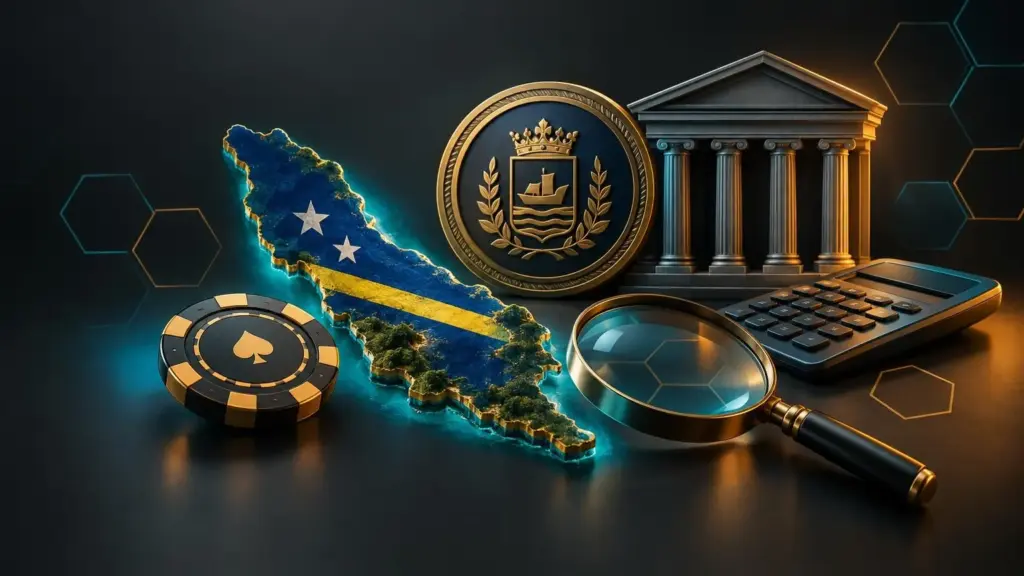
A Curaçao gaming licence is a permit from the Curaçao Gaming Authority (CGA) that lets an operator offer online casino, sports betting, poker and lottery games. It replaced the old master-licence and sub-licence model when the National Ordinance on Games of Chance (LOK) came into force on 24 December 2024. For a player, the licence is a useful first check that a casino is regulated, but it does not by itself promise refunds or fair outcomes.
This guide explains what the licence is, what it costs an operator, how to verify one and how disputes are handled. It is written for players researching a casino, not for businesses applying for a licence. See our licence guides for the full range of regulators we cover.
What is a Curaçao gaming licence?
A Curaçao gaming licence is issued by the Curaçao Gaming Authority (CGA), the regulator based in Willemstad, under the National Ordinance on Games of Chance (LOK, Landsverordening op de kansspelen), in force since 24 December 2024. There are two classes: a B2C licence for operators that take bets from players, and a B2B licence for suppliers such as game developers and platform providers.
A single B2C licence covers casino games, sports betting, poker, live dealer games and lottery under one permit. The CGA does not allow one company to hold a B2C and a B2B licence together. This replaces the older arrangement in which a casino held a sub-licence from a private master-licence holder rather than a direct permit from the regulator.
You may still see the older name Curaçao Gaming Control Board (CGCB) on some pages. Today the regulator operates as the Curaçao Gaming Authority, and its site is cga.cw. That older domain, gamingcontrolcuracao.org, no longer resolves, so treat it as outdated.
What changed when the LOK took effect on 24 December 2024?
Before the LOK, most online casinos ran under a sub-licence from one of a handful of private master-licence holders, a system based on the 1993 National Ordinance on Offshore Games of Hazard (NOOGH). The LOK, in force since 24 December 2024, ended that model. Those master licences expired in early 2025, and every operator must now hold a direct licence from the CGA.
For players, the practical effect is simpler: a licence now comes from one regulator rather than from a chain of private companies. Old references to ‘Curaçao eGaming’ and ‘8048/JAZ’ sub-licences describe the expired system, not the current one. When a casino shows a Curaçao licence, check that it is a current CGA licence rather than an old sub-licence number.
The reform has a clear timeline:
- 1993: the National Ordinance on Offshore Games of Hazard (NOOGH) introduced Curaçao’s gambling rules
- 1996: licence issuance began under NOOGH
- 2023: the Ministry of Finance announced the reform and the new direct-licensing model
- 24 December 2024: the LOK came into force
- Early 2025: the old master licences expired
- 15 October 2025: the CGA published its fee schedule version 2.0
How much does a Curaçao gaming licence cost?
For a B2C operator the CGA fee schedule, version 2.0 dated 15 October 2025, sets a one-off €4,592 application fee and an annual fee of €47,450, split into €24,490 to the National Treasury and €22,960 to the CGA. A B2B supplier pays the same €4,592 to apply and €24,490 a year. The fees are fixed sums: the schedule lists no percentage tax on gaming revenue.
| Fee item | Amount | When it is due |
|---|---|---|
| Application fee, B2C or B2B | €4,592 | One-off, non-refundable |
| UBO or qualified interest holder check | €150 per person | With the application |
| Listed UBO | €2,551 per entity | With the application |
| Annual B2C fee | €47,450 (€24,490 Treasury + €22,960 CGA) | 15 January each year |
| Annual B2B supervisory fee | €24,490 | 15 January each year |
| Extra domain | €250 | Per domain |
| Certificate application | €383 | Per application |
The figures above come from the CGA’s Licence Fees schedule, version 2.0 of 15 October 2025, reproduced by AGB and NUR Legal. In year one, fees are prorated: the CGA invoices an initial six-month period, with a second six-month invoice where the licence continues. From year two, the full annual fee is due by 15 January each year, and all fees are non-refundable.
Licences run on an indefinite term rather than a fixed annual renewal: an operator stays licensed by paying the annual fee each January. CGA fees are published in euros; older pre-LOK tables quoted amounts in Netherlands Antillean guilders (ANG), so ignore those old ANG figures when budgeting.
That licence fee is only part of the cost. Operators also pay for a Curaçao company, a resident director, compliance staff and game certification. Legal advisers put the realistic first-year total at €70,000 to €110,000 for a B2C operator, falling to roughly €55,000 to €85,000 a year from year two.
- Company incorporation in Curaçao: about €3,000 to €5,000 one-off
- Local managing director: about €6,000 to €12,000 a year
- Registered office and local contact: about €2,000 to €4,000 a year
- Compliance officer: about €10,000 to €25,000 a year
- Money-laundering reporting officer: about €5,000 to €12,000 a year
- Legal and application advice: about €15,000 to €30,000 in year one
- AML and KYC infrastructure: about €10,000 to €25,000 a year
Does a Curaçao licence cover cryptocurrency casinos?
Yes. The LOK framework accommodates cryptocurrency deposits and withdrawals, and Curaçao licences are common at crypto casinos. That permit supervises the operator, not the coins: it neither requires nor forbids bitcoin, ether, USDT or any other token. What you deposit does not change the complaint route described below.
The practical points are the same as at any crypto casino. Send only from a wallet you control, check the network and the minimum, and expect know-your-customer checks before large withdrawals. See our cryptocurrency payment guide for the mechanics.
A casino can hold a Curaçao licence and take crypto, or it can hold the same licence and run fiat-only banking. The licence tells you who supervises the operator, not which payment rails it uses, so check the banking and withdrawal details on the casino’s own terms page.
Worked example: if a casino accepts bitcoin with a 0.0005 BTC minimum deposit (an illustrative amount), a 0.01 BTC deposit clears once the Bitcoin network confirms the transaction. Withdrawal minimums, network fees and any identity checks are set by the casino, not by the licence, so read them in the terms before you send.
How do you verify a casino’s Curaçao licence?
Check the casino’s licence number against the CGA register, not against a logo on its own site. The CGA publishes licensed operators and runs a licensing portal at portal.cga.cw. Note the recent disruption: the CGA confirmed unauthorised access to its systems on 17 and 22 September 2026 and launched an interim online gaming portal on 19 October 2026, while saying existing licences remain valid.
- Find the licence number and digital seal on the casino’s footer or terms page.
- Open the CGA site or portal and look up the operator’s registered company name.
- Confirm that the company name on the register matches the name in the casino’s terms.
- Check that the seal and licence are current, not a copied screenshot of an old licence.
- If anything is unclear, treat the licence as unconfirmed rather than assuming it is valid.
Licence holders appear on a public register and display a colour-coded digital seal under the new system. The register and portal were affected by the September 2026 incident, so if the portal is down, check cga.cw for the latest notice.
An old master-licence or sub-licence number, or a logo reading ‘Curaçao eGaming’, is not the same as a current CGA licence. If a casino’s footer still shows an 8048/JAZ-era number, look it up on the CGA register for its current status before you deposit.
What does a Curaçao licence actually protect?
A Curaçao licence means the operator passed integrity and financial checks and must maintain anti-money-laundering, know-your-customer and responsible-gambling procedures, but it does not guarantee you will be paid every time and the CGA will not mediate an individual dispute. The licence does not change the house edge either. For example, a game advertised at 96% return-to-player keeps a 4% edge, so for every €100 wagered the expected long-run loss is about €4, whoever issued the licence.
Think of the licence as a compliance baseline, not a guarantee of outcomes. It confirms the operator exists, is supervised and must keep player funds separate from operating funds, but it cannot make a losing bet win. Set limits you can afford, and remember the house edge means the player loses on average over time. That holds whether a game is provably fair or audited by a testing lab; see our provably fair games guide for how fairness can be checked.
Operators must also verify identity on larger transactions; one provider guide cites an AML check threshold of ANG 4,000. Players must be at least 18, and operators must refuse registration to residents of the United States and the Dutch Caribbean, alongside any other restricted countries listed in their terms.
If gambling stops being fun, most licensed casinos offer deposit limits and self-exclusion, and free help is available at gamblersanonymous.org and gamblingtherapy.org. Our responsible gambling page has more, and how we rate casinos explains how we weigh licences in reviews.
How do you complain about a Curaçao-licensed casino?
Start with the casino’s own complaints process, in writing, and keep records. If that fails, you can escalate to one of the seven CGA-certified alternative dispute resolution (ADR) bodies in the CGA’s list dated 31 August 2026; they operate under Article 5.17 of the LOK. The CGA itself does not step into individual disputes between a player and an operator.
Those ADR bodies are independent of both the operator and the regulator. In August 2026 the CGA expanded the list, adding the Independent Betting Adjudication Service (IBAS) from 27 August 2026 alongside existing providers such as Resolvo Curaçao N.V. and ADR Curaçao B.V.
Do not confuse ADR bodies with testing laboratories. Separately, the CGA certifies testing labs such as eCOGRA Limited, Quinel Limited and BMM Spain Testlabs to check games and random number generators; those labs do not settle player disputes.
How does Curaçao compare with Malta, Kahnawake and Anjouan?
Curaçao is the licence you will meet most often at crypto casinos, and it is a real, current regime now that the LOK has been in force since 2024. For player protection the key point is the same across Curaçao, Malta and Anjouan: none of the three regulators will mediate your individual dispute. Choose based on the casino’s own record and the ADR route on offer, not the licence name alone.
| Dimension | Curaçao (CGA) | Malta (MGA) | Anjouan |
|---|---|---|---|
| Regulator mediates individual disputes? | No | No (Player Support Unit stopped 1 April 2019) | No |
| First step for a complaint | Casino’s own process | Casino’s own process | Casino via the site seal (30 days) |
| Next step | One of 7 CGA-certified ADR bodies (list 31 August 2026) | ADR, e.g. eCOGRA | Operator-paid ADR |
| Framework | LOK, in force 24 December 2024 | MGA licensing regime | Anjouan licence rules |
The Malta Gaming Authority (MGA) is a longer-established European regulator. Its Player Support Unit stopped ruling on individual disputes on 1 April 2019, so players now use an approved ADR body such as eCOGRA. Anjouan is a newer offshore option: complaints start through the site seal, the operator has 30 days, game-outcome disputes must be raised within 14 days, and the operator then pays for ADR.
Kahnawake, a separate First Nation regulator in Canada, was founded on 10 June 1996 and has licensed online gaming since 8 July 1999; see our Kahnawake Gaming Commission page. The UK Gambling Commission is a different case again: it licenses operators that serve Great Britain, while this site is aimed at international players outside the US and UK.
Tobique, another First Nation regulator in New Brunswick, Canada, sits in the same smaller-jurisdiction group. None of these licences is a mark of approval from us; we treat a licence as one fact among several when we review a casino.
What must an operator do to hold a Curaçao licence?
An applicant incorporates a local N.V. or B.V., registers with the Curaçao Chamber of Commerce, appoints a Curaçao-resident managing director, and names a money-laundering reporting officer (MLRO) plus a compliance officer who cannot also be the chief executive. Games and random number generators must be certified by an accredited testing laboratory, and the operator must run AML and KYC checks before it can launch.
The CGA assesses applications in two phases. Phase one checks integrity, ownership, source of wealth and financial stability, with a target of about eight weeks. Phase two checks technical and compliance matters, again about eight weeks. A provisional licence can run for up to six months, and a clean application typically takes three to five months end to end.
Applications also carry a paperwork burden. The CGA and advisers typically ask for notarised passports, a clean criminal-record certificate, a utility bill under three months old, CVs for directors and compliance staff, a bank reference, a professional reference and proof of source of funds. A three-year business plan and an operational manual describing games, payouts, limits and identity checks are usually required as well.
Operators must block players under 18 and players in restricted jurisdictions, and most Curaçao-licensed casinos exclude players from the United States, the United Kingdom and several other markets. If you are in a restricted country, the casino should refuse your registration. US readers can see our crypto casinos USA page instead.
FAQ
How much does a Curaçao gaming licence cost?
The CGA fee schedule (version 2.0, 15 October 2025) charges a €4,592 application fee and a €47,450 annual fee for a B2C operator, or €24,490 a year for a B2B supplier. Annual fees are due by 15 January each year, and all fees are non-refundable.
Is a Curaçao gaming licence safe for players?
The licence means an operator is supervised and must meet AML, KYC and responsible-gambling rules, but it does not guarantee refunds and the CGA does not mediate individual disputes. Treat it as a compliance baseline, and check the operator’s record and its ADR route before you deposit.
How long does it take to get a Curaçao gaming licence?
A clean application typically takes three to five months end to end, through two review phases of about eight weeks each. A provisional licence can run for up to six months while an operator finishes outstanding requirements.
What is the difference between a B2C and a B2B Curaçao licence?
A B2C licence lets an operator take bets from players across casino, sports betting, poker, live dealer and lottery. A B2B licence covers suppliers such as game developers and platform providers. One company cannot hold both types at once.
Can a Curaçao casino refuse to pay my winnings?
An operator can withhold or void winnings under its terms, for example for bonus abuse or a terms breach. If you disagree, complain to the casino first, then escalate to one of the seven CGA-certified ADR bodies. The CGA will not rule on your case directly.
How do I check if a casino’s Curaçao licence is valid?
Find the licence number and digital seal on the casino’s site, then check the operator’s company name against the CGA register at cga.cw or the licensing portal. If the portal is down after the September 2026 incident, look for the latest CGA notice before trusting a logo.
Sources
- Curaçao Gaming Authority (CGA)
- CGA Licensing Portal
- CGA, Licence Fees under the LOK, v2.0 (15 October 2025)
- AGB: Curaçao issues updated fees guidance under LOK framework
- NUR Legal: October 2025 Curaçao Gaming Authority updates LOK fees
- Point Legal: Curaçao Gaming Licence Cost (2026)
- Curaçao Chronicle: Curaçao Gaming Regulator Expands Certified Dispute Resolution System
- Manavia: Curaçao Online Gambling Licensing
- SOFTSWISS: Curacao iGaming licence guide

About the author
Lukas Brandt
Lukas Brandt writes our wallet, payment and crypto guides: how deposits, networks, fees and confirmations work, sourced from the protocol and wallet docs.